I finally started building with AI
I deliberately put off learning how to build with AI. Then a real business problem finally gave me a reason to start.
A few weeks ago, I wrote a LinkedIn post about why I was deliberately not learning how to build with AI.
I was using AI for research, thinking through problems, and writing drafts.
But everyone around me seemed to be building things.
I had FOMO.
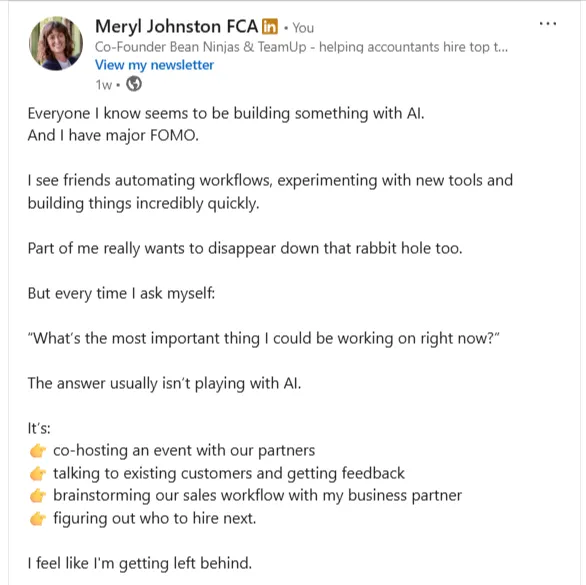
But building with AI wasn’t going to solve the most important problems in either of my businesses.
People kept asking how we were using AI in our recruitment process at TeamUp. But recruitment wasn’t our bottleneck. Our gross margins were good, and we had spare recruiter capacity.
We needed more sales.
Spending hours playing with Claude Code, Cursor or Grok Bot just because everyone else is, feels like exactly the kind of decision I try to avoid.
So I told myself it was ok to be behind.
It didn’t feel good, but I think it was the right business decision.
Then a real project finally rose to the top of my list.
I want to rebuild the marketing systems at both Bean Ninjas and TeamUp to be AI-first.
And I decided to start with our websites.
Learning what’s possible
Last week, I downloaded the Claude Desktop app for the first time.
Before then, I hadn’t used Claude Cowork or Design or built anything with Claude Code.
It’s been a steep learning curve.
I’ve been watching YouTube videos, working through AI course material, and reading AI newsletters. I’m also in the AI for Accountants Lab and No FOMO Club communities.
And I’ve been getting on calls with people who are further ahead than me.
Seeing what other people have built is really useful. It gives me ideas.
But I’ve also found it overwhelming.
Particularly when someone is a long way ahead.
You start a conversation wanting to learn one thing and come away hearing about agents, automations, apps, and another ten tools you’ve never heard of.
Suddenly your list of things to learn is twice as long.
I’ve found the most useful conversations are much narrower.
Rather than asking someone to show me everything they’re doing with AI, I’ve been asking for walkthroughs of specific setups that relate to the project I’m working on.
I want to keep paying attention to how other people are using AI because it expands my thinking about what’s possible.
But I want about 90% of my learning to be connected to projects I’m currently working on.
Otherwise, I can see myself spending a lot of time learning about AI without putting any of it into practice.
Starting with a test project
The bigger plan is to rebuild the TeamUp and Bean Ninjas websites so they’re easier to work on with AI, making it faster to update pages, publish articles, and improve SEO.
But neither seemed like a good place to learn.
They’re important business assets and I don’t want to mess them up while I’m figuring out what Git does. 😂
So I used my personal website as the test project.
It was a small, low-risk project.
A couple of weeks later, the new site is live.
I wrote a separate article about the before and after and what went into the rebuild, so I won’t repeat all of that here. But the short version is that I went from having very little understanding of how modern websites are built to taking one through design, a local build, GitHub, Cloudflare, DNS and finally getting it live.
Most of it only started to make sense once I was building something.
Understanding just enough
One thing I’m getting more comfortable with is not understanding everything.
When I started, every new term sent me down another rabbit hole.
- Git / GitHub
- Cloudflare
- Sanity
- Npm
- Astro
I felt like I needed to understand all of it.
But I don’t.
I need to understand the next thing well enough to make a sensible decision and keep going.
Sometimes that still means disappearing down a rabbit hole. And sometimes it means knowing when to stop.
A YouTube video recently recommended a third-party UI/UX tool and told me to install it “globally using npm.”
I didn’t know what that meant. But installing something globally sounded like it could have security implications, so instead of blindly pasting the command into the terminal, I stopped and researched the risks. In the end, I decided the tool wasn’t worth the risk.
One of the skills I’m developing is knowing when I understand enough to keep going, and when I need to stop and learn more.
Keeping the scope small
Building with AI has opened up a lot of possibilities.
But I’m trying not to turn all of those possibilities into projects.
There will always be another tool to try, something new to learn or another thing I could build. I’m interested in building apps. I’m also interested in AEO and GEO.
But neither is part of the project I’m working on now.
SEO is. I already understand it, and improving SEO alongside the website rebuild doesn’t add much complexity.
AEO and GEO feel like a separate project, so I’m leaving them for later.
I’m trying to get better at keeping the scope small enough that I can move quickly and finish what I start.
Next: working with an expert
I’m now planning the TeamUp website rebuild. Then we’ll tackle Bean Ninjas.
This time I’ll work with a developer.
My personal website was a good place to experiment and get things wrong. These websites aren’t. I don’t want to accidentally tank our SEO or lose traffic because I decided I was a developer after two weeks. 😂
But I don’t want to hand the whole project over either.
The last few weeks have given me enough understanding to be much more involved in the decisions, ask better questions and work more effectively with experts.
I’m interested to see what that collaboration looks like.
AI is changing what I can do myself. I’m interested to see how that changes the way I work with developers, designers and copywriters.
For now, my approach to learning AI is becoming pretty simple:
Work on real business problems. Learn what I need as I go. Finish things before chasing the next interesting idea.
We’ll see how long I manage to stick to that. :)